The generator serves critical loads with little tolerance for downtime
Hospitals, data centers, continuous production and major commercial facilities should pre-position high-impact consumables, common failure parts and a response path.
Power-System Component / Operating Support and Service
Delivery is not the end of generator reliability. Equipment records, commissioning spares, service consumables, critical failure parts, maintenance plans, site training and response boundaries should be defined during the project so mismatched parts and missing records do not create avoidable downtime.
Why Plan Before Handover
The customer value is shorter time to identify the fault, locate the correct part, procure it and restore service. Accurate part numbers, proper storage, traceable consumption and a replenishment rhythm matter more than an oversized but unusable inventory.
Hospitals, data centers, continuous production and major commercial facilities should pre-position high-impact consumables, common failure parts and a response path.
Set site stock around transport time, local availability and equipment quantity so a small part does not extend a repair into a long outage.
Filters, belts, sensors, controllers and electrical parts must match engine, alternator and controller models and serial numbers.
Batteries, rubber parts, fluids, seals and filters have storage requirements; untracked stock may be unusable when it is finally needed.
Support Loop from Equipment Record to Return to Service
Spares are one part of the loop. Models and serial numbers determine compatibility, hours and environment determine maintenance, and site skills and service distance determine stock depth. Every repair should also update test and replenishment records.
Keep model and serial data, nameplates, technical documents, settings, wiring diagrams and supply lists.
Retain no-load, loaded, transfer, alarm and battery results and verify part numbers, quantities, batches and storage locations.
Adjust manufacturer guidance for heat, dust, humidity, light loading and prolonged standby instead of applying one interval blindly.
Track leakage, levels, charging, terminals, looseness, noise, ventilation, alarms and automatic mode before conditions worsen.
Share alarm codes, controller photos, operating data, event timing and site video to reduce repeated questions and incorrect part replacement.
Confirm cause and action, complete a no-load or loaded retest, update equipment records and replenish below-minimum stock.
Spares and Maintenance Configurations
The quotation should state which materials are supplied, which equipment they fit, which maintenance stage they cover, who stores and replaces them and when replenishment is triggered.
Covers installation, commissioning and early service needs with filters, seals, connection items and necessary tools or labels.
Matches oil, fuel and air filters, belts, fluids and related items to the engine model, capacities, operating hours and environment.
Select batteries, chargers, starters, sensors, relays, controllers or electrical parts by failure impact and local availability.
Defines minimum and maximum stock, batch rotation, replenishment, training, inspection and remote-support boundaries for fleets or remote sites.
Maintenance intervals and spare quantities must follow the exact make and model, manufacturer requirements, operating hours, environment and acceptable downtime. Three-, six- or twelve-month intervals are not universal standards.
Maintenance Triggers and Parts Categories
Routine consumables, critical failure parts and long-storage items have different procurement logic. Put maintenance triggers and stock categories in one plan so service is not delayed by missing materials or undermined by stagnant inventory.
Physical Spares and Handover Evidence
Spare-parts quality is more than brand. Part-number fit, new condition, moisture and dust protection, batch and shelf life, kit labels, storage, delivery lead time and issue records determine whether a part can actually restore the generator.
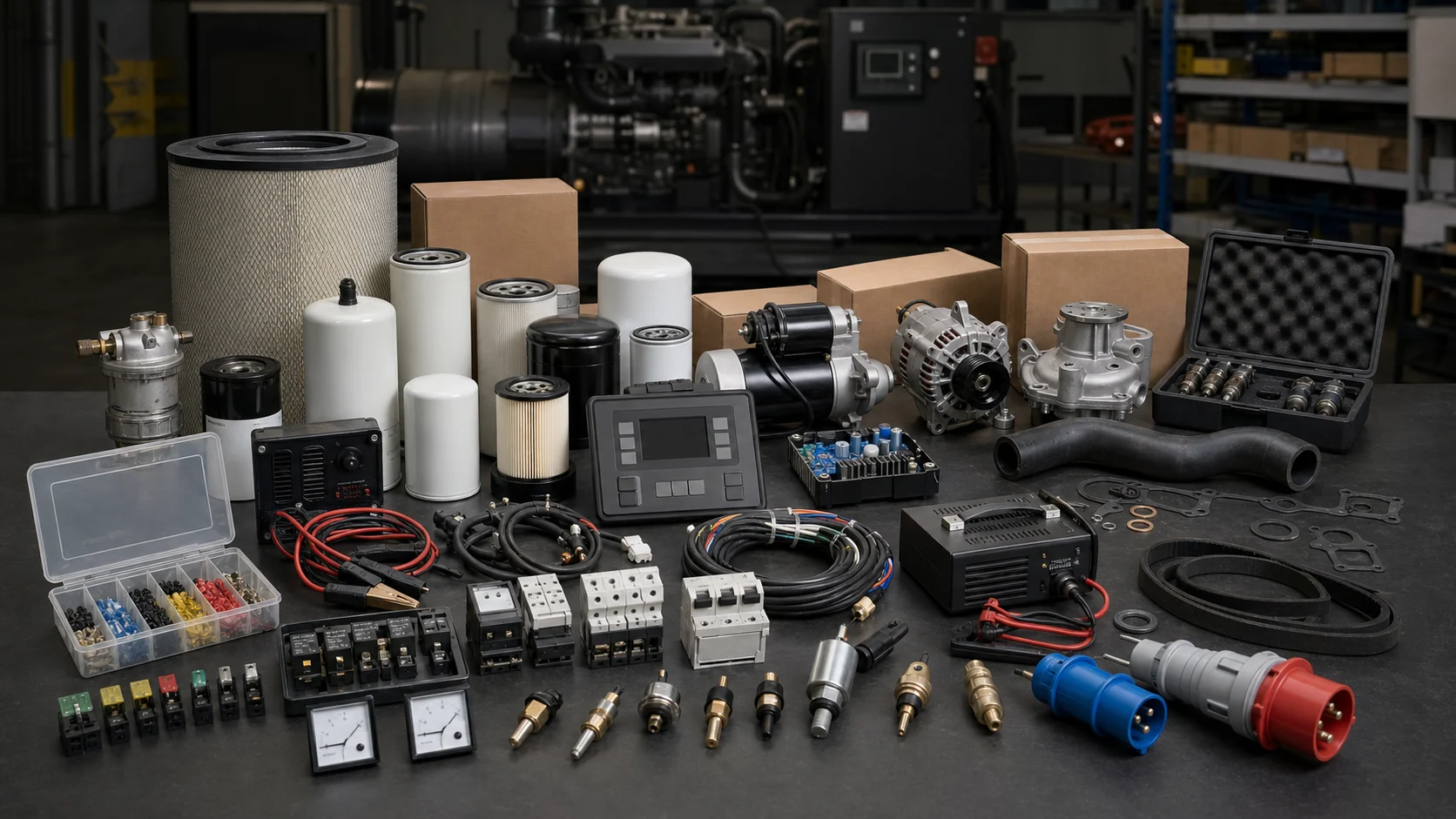
Parts lists should connect each item to the exact engine, alternator, controller, ATS or switchboard model and serial number.
Verify brand, labels, packaging, batch and necessary manufacturer or qualified-supply documentation.
Filters, electrical parts, sensors, seals and metal items need appropriate moisture, dust, static or corrosion protection.
Record manufacture date, expiry and first-in-first-out rules for batteries, fluids, rubber and sealing materials.
Pack by equipment, maintenance interval or fault task and keep external labels consistent with the internal list.
Verify temperature, humidity, racking, water protection, sunlight and loading so stock does not fail in storage.
Define local stock, regional stock, international freight, customs and emergency shipping against acceptable downtime.
Record the part, reason, equipment and date for every replacement and replenish stock below its minimum.
Six Project Inputs
Provide engine, alternator, controller, ATS, paralleling, distribution and auxiliary-system nameplates and current parts lists.
Describe operating pattern, recent maintenance, current stock, fault history and the next one or two service events.
Confirm local brand support, common-part sources, international freight and customs to identify items that must remain on site.
Use outage loss, standby equipment, redundancy and recovery targets to prioritize critical spares.
Define checks and replacements that site staff can perform and tasks needing remote guidance or specialist attendance.
Confirm storage conditions, inventory owner, stock limits, fault reporting, remote support and local service boundaries.
Typical Operating-Support Tasks
Hospitals and data centers focus on batteries, charging, controls, ATS, cooling and fuel-system spares with test, replacement and replenishment records.
Hotels, malls and schools can build equipment-specific maintenance packs and fault-report templates for property teams.
Factories, campuses and remote sites set clearer stock and service plans around production loss, equipment count and transport time.
Share models and serial numbers, run hours, service history, critical loads, existing stock, local availability, site capability and acceptable downtime. HOHANK engineers will define spares scope, maintenance triggers, replenishment rules and service boundaries.