Engineering support

From mine power problems to an executable power system configuration plan

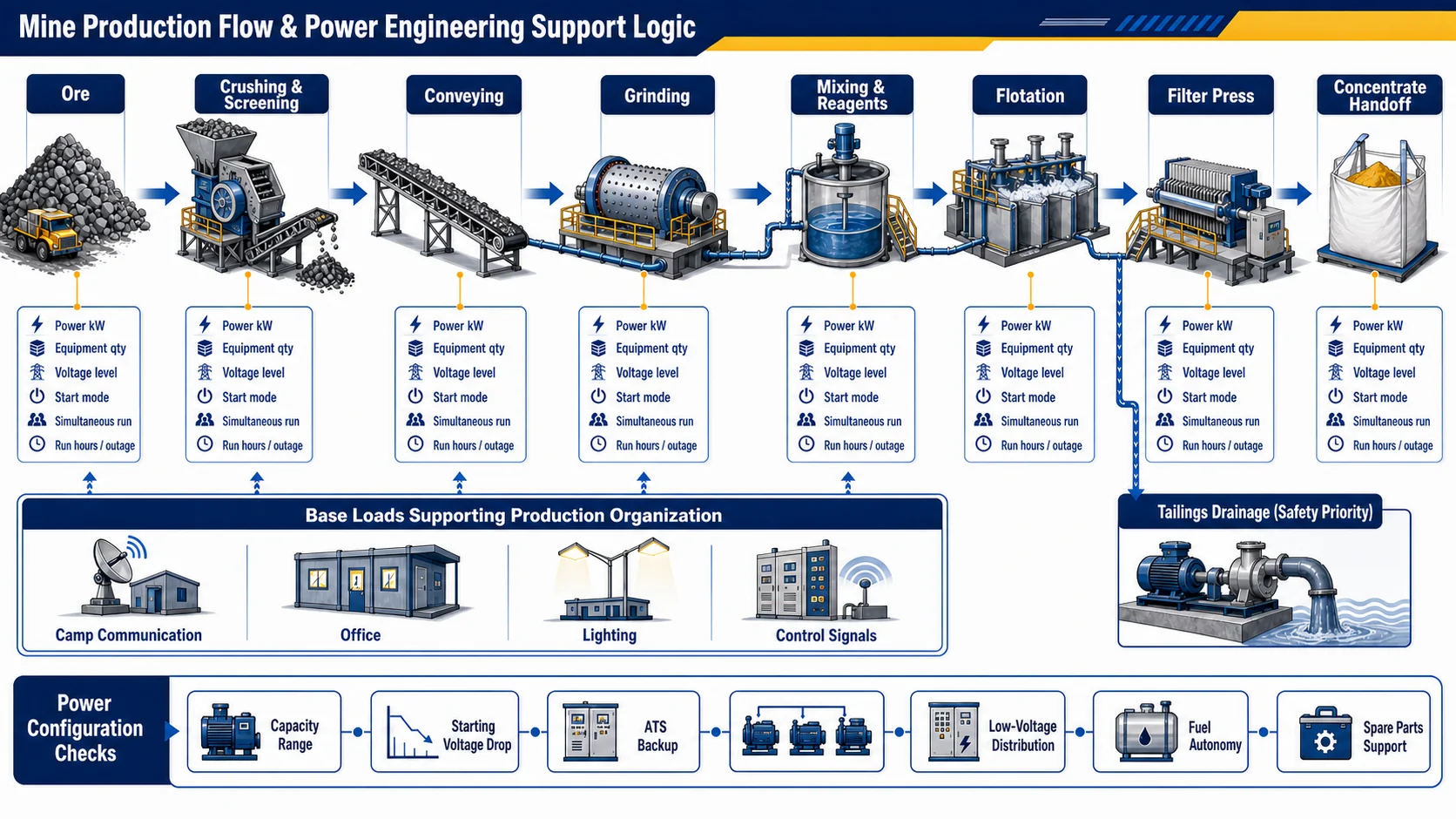
If the mine faces unstable grid power, difficult starts, dewatering backup needs, or limited capacity after expansion, engineers first map the real production flow, including camp communications, crushing, processing, and tailings/dewatering. Then they review critical loads, diesel generator capacity, ATS, paralleling, low-voltage distribution, fuel autonomy, and spare-parts configuration.

From current production to expansion planning

Engineers map current loads and expansion plans around the mine production flow

The engineering review does not stop at one piece of equipment. It starts with mine production: how the site operates today, which steps depend on power, and which loads expansion will add. The engineering team then defines camp loads, crushing, grinding / agitation / flotation / filter press, tailings/dewatering, ATS backup, paralleling, low-voltage distribution, fuel autonomy and spare-parts support in one plan, so current production and future growth are handled together.

Derive power requirements from the production process

Understanding mine production is how power requirements are separated correctly

Mine production flow and power engineering support logic diagram: from ore, crushing and screening, conveying, grinding, reagent mixing, flotation and filter press to gold concentrate handoff, with base loads, tailings drainage and power configuration checks marked.
BaseCamp, communications and offices
  • Which communication, office, lighting and control-signal loads must not lose power?
  • How many kW is each load, how many units are there, what voltage level, and how many hours per day does it run?
  • How long can it lose power, and must it be connected to ATS for priority recovery?

Whether they belong on ATS backup, whether low-voltage distribution needs separate circuits, and whether reserve capacity is kept for base loads.

01Crushing
  • How many kW and how many units are there for crushers, screens and conveyors?
  • Is the starting method direct-on-line, soft start or VFD?
  • Does it start or run together with the processing line?

Capacity cannot be based only on rated power; starting voltage drop, staggered starting, paralleling or soft-start conditions must be reviewed.

02Grinding
  • How many kW and how many units are there for mills, grinding pumps and process pumps?
  • Does it run continuously or by shift, and how many hours per day?
  • Will shutdown affect agitation, flotation and delivery rhythm?

Review continuous load rate, backup unit engagement, fuel autonomy, ventilation and heat-dissipation conditions.

03Agitation
  • How many kW and how many units are there for agitation tanks, reagent pumps and slurry pumps?
  • Which equipment must run continuously, and which can recover in stages?
  • Will a short outage affect reagent ratio and downstream flotation?

Decide which circuits need stable power and which can recover in stages, so all loads do not hit the generator set at once.

04Flotation
  • How many kW are the flotation cells, blowers, slurry pumps and control systems?
  • Which circuits are most sensitive to voltage fluctuation?
  • Does the site already have control cabinets, backup circuits and critical spare parts?

Voltage stability, control circuits, backup circuits and critical spare parts must be considered to reduce repeated downtime.

05Filter press
  • How many kW and how many units are there for filter presses, feed pumps and conveyors?
  • Must it run continuously with upstream processes, or can it run off peak?
  • Have power-cabinet outgoing feeders, protection and maintenance space been confirmed?

Review whether end loads can run off peak, and whether power-cabinet outgoing feeders, protection and maintenance space are sufficient.

Safety priorityTailings and dewatering loads
  • What are the kW, quantity and duty for tailings/dewatering pumps, water pumps and safety lighting?
  • In rainy season, how long must it run continuously, and how long can it lose power?
  • Must these loads recover before ordinary production loads?

This maps to ATS, reserve capacity, low-voltage distribution and spare-parts preparation so critical safety loads can recover first after an outage.

Mine power profile

Build a mine power profile and keep tracking load changes and system upgrades

The engineering team builds a mine power profile that records production flow, critical loads, equipment list, site conditions, running records and expansion plans. Later inspections, maintenance, after-sales troubleshooting and mine expansion all follow that same profile, so support does not start from zero and the company can solve power issues as production grows.

01 Production and load profile

Records site areas and process steps such as camp, communications, crushing, grinding, agitation, flotation, filter press and tailings/dewatering, plus power, quantity, start mode, running hours and allowable outage time for each load type.

02 Equipment and site profile

Records generator sets, ATS, paralleling, low-voltage distribution, fuel system and spare parts scope, as well as altitude, dust, rainy-season roads, installation space, cable distance and site photos.

03 Operation and service record

Records operating hours, load changes, alarms, maintenance history, spare-parts replacement and expansion planning so every inspection, maintenance visit and service decision has continuous context.

Long-term follow-up service

Not only one purchase; a long-term profile for production growth

  • During inspections and maintenance, engineers review load changes, running hours, alarms and maintenance status based on the profile.
  • During after-sales troubleshooting, engineers first compare equipment history, fault records and spare-parts scope before judging the likely issue.
  • During mine expansion, engineers review new equipment, production targets and existing system margin together to reduce repeated mistakes.

Engineer contact

Contact an engineer

Scan WhatsApp to contact an engineer

An engineer will contact you soon to review your site issue and needs.

Scan WhatsApp to contact an engineer WhatsApp: +86 176 8575 2779
Email an engineerfeyqiao@hohank.com
or leave your contact information

An engineer will contact you soon to review your site issue and needs.

Contact an engineer